Vagrant Story
Let's talk about Vagrant Story! ...Or rather, let me talk about Vagrant Story at you for an indeterminate amount of time, because this is one of those games that does not fit neatly into a paragraph and I have never in my life managed to be brief about it. I'm so sorry about this...
Released in 2000 for the PlayStation 1 by Squaresoft, directed and written by Yasumi Matsuno, the man responsible for Final Fantasy Tactics and later Final Fantasy XII, Vagrant Story is one of the most singular, strange, and brilliant thing the medium has ever produced. And... it was a commercial disappointment? While receiving a perfect score from Famitsu, making it one of only five games in the magazine's history at the time to achieve that distinction. Both of those things are true simultaneously, and together they tell you almost everything you need to know about it.

You play as Ashley Riot, a Riskbreaker, which is the Ivalice equivalent of James Bond, sent to investigate the cult leader Sydney Losstarot after his followers seize the manor of Duke Bardorba. Ashley shoots Sydney through the heart in the opening minutes of the game. Sydney pulls the bolt out, summons a wyvern mentioned only in legend, and calmly leaves the scene with the Duke's six year old son as a hostage. The game then sends Ashley into the ruins of Leá Monde, a city destroyed by earthquake twenty-five years prior that is now a labyrinth of catacombs, temples, and underground caverns teeming with monsters and soaked through with a supernatural darkness that does something to the people who enter it. Yes, all of this just in the game's opening. It gets crazier from here onward.
The story is, to put it plainly, Shakespearean. Matsuno was reportedly inspired by everything from Shakespeare to Jet Li, and it shows in the best possible way. Multiple factions converge on Leá Monde: the Parliament, the Church militant under the sinister and power-hungry Romeo Guildenstern, and the VKP's own internal intrigues. Everyone has an agenda. Nobody is telling the full truth. Allegiances shift. The ground keeps moving under your feet narratively, and what looks like a story about chasing a cult leader across a haunted city reveals itself to be something considerably darker and considerably more interesting. Ashley himself is not the heroic avenger he believes himself to be. Sydney is not the villain he appears to be. The game asks hard questions about memory, guilt, and what we choose to believe about ourselves, and it does not give you clean answers. By the end, with the final text reading "and so began the story of the wanderer, the vagrant," you are left with the distinct feeling that the real story was only just starting.
It also takes place almost entirely within a single twenty four hour period, which is an astonishing structural choice that gives the whole thing an almost theatrical urgency.

I want to linger on the central relationship because it is genuinely extraordinary. Ashley Riot is a man in his late twenties with copper hair tied back in a knot with two strands sticking up like antennae, which is either an iconic design choice or a deeply funny one depending on your mood, wearing military gear and sandals and, most famously, what can only be described as assless chaps. This is intentional. Akihiko Yoshida, the game's character designer, has been known to have strong opinions about the human form, and Ashley's outfit is very much a reflection of that. It is simultaneously one of the most absurd character designs in PlayStation era gaming and one of the most iconic. The man fights ancient monsters in the ruins of a cursed city with his entire lower posterior simply present and accounted for in every cutscene. It is impossible not to respect.
Beneath the chaps, Ashley is a meticulously constructed character: stoic, capable, deeply damaged in ways he does not fully understand. His relationship with Sydney is the game's real spine. Sydney is everything Ashley is not on the surface: theatrical, manipulative, seemingly immortal, terrifyingly intelligent, and possessed of powers over the Dark that he deploys with enormous flair. He spends most of the game goading Ashley forward, testing him, showing him glimpses of a past Ashley has suppressed. What eventually emerges is that Sydney is an anti-villain of the highest order. His elaborate, painful, years-long plan is a heroic sacrifice dressed up as villainy. He knows exactly what he is doing and exactly what it will cost him, and he does it anyway. The moment he responds to Rosencrantz demanding to be named his successor with simply "I name you... worm, as you crawl through the dust" is one of my favourite lines.
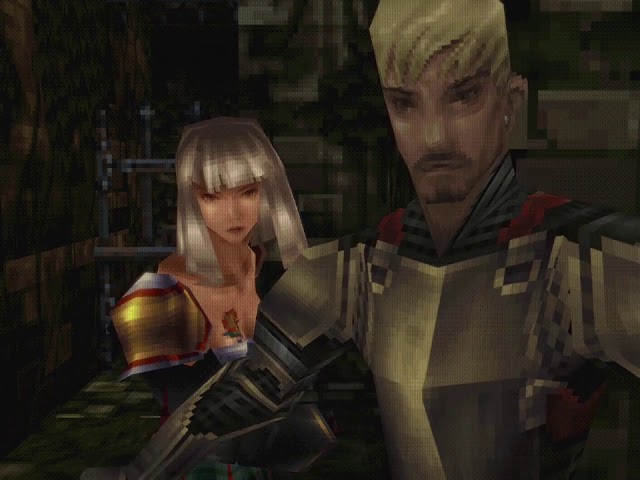
Then there is Romeo Guildenstern, the game's actual villain: a righteous, pious paladin who is, beneath the religious facade, purely and straightforwardly monstrous. He sacrifices his own lover to seize the power of the Dark without a single moment of hesitation. He is what Sydney only appears to be, and the contrast between them is the whole thematic point of the game.
Now, as for the gameplay. This is where I have to be honest with you.
The gameplay of Vagrant Story is, to put it charitably... an acquired taste. The combat system is genuinely innovative: you fight in real time with visible enemies, pausing to target specific body parts of enemies with precision, chaining attack sequences for combo damage while managing a Risk gauge that rises with each hit and makes you increasingly likely to miss if you let it climb too high. Weapons are not purchased from shops, because there are no shops. There is no economy. There are no friendly NPCs. There is only Ashley, the dungeon, and the workshop system, which lets you break down weapons into components, combine them, add elemental gems, and assemble entirely new equipment by fusing two weapons together. Different weapon types deal more damage to different enemy categories. The sword you used to cut through undead is useless against golems. The one you tuned against beasts is the wrong choice for the next area's demons.
It is a system of enormous depth and genuine satisfaction once you understand it. Getting there is another matter. The interface for weapon management is a monument to unintuitive design, requiring you to open multiple nested menus to swap equipment mid-fight, with no quick access system to speak of. This was noted as a significant problem at release and it remains one today. The game is also deeply, sincerely difficult, especially early on before you understand how the crafting system functions and which weapons you should be investing in for the next area's enemy types. There is a dungeon in the Abandoned Mines involving a timed maze in near darkness with respawning enemies and trapped rooms that I am including here as a formal warning. You will know it when you get there...
All of that said: the combat is not bad. It is demanding and it rewards mastery in a way that very few games of its era bothered to attempt. When it clicks, it is enormously satisfying. The New Game Plus, which lets you carry your end-game weapons and stats into a new run and unlocks bonus dungeons and optional bosses, is one of the most well-designed post-game systems of its generation.
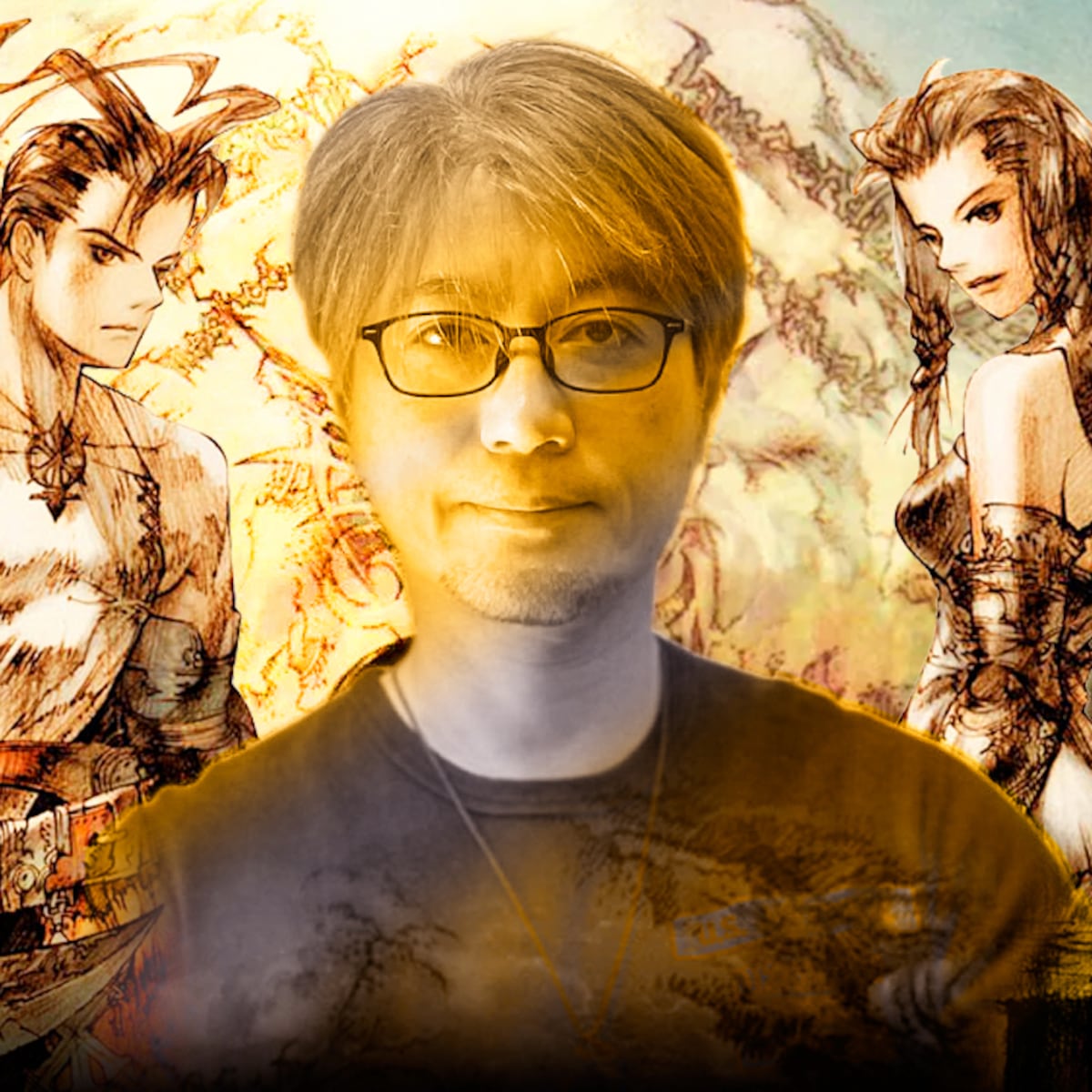
Before we go any further with the art, we need to talk about the man behind all of it, because Vagrant Story does not exist without Yasumi Matsuno and Yasumi Matsuno is one of the most fascinating and quietly tragic figures in the history of gaming.
Born in 1965, Matsuno grew up in a rural area where his entertainment was, by his own account, almost entirely movies, television, and books. He made World War II dioramas as a hobby and researched them at the local library, which tells you everything you need to know about the kind of mind he had before he ever touched a game development tool. He dropped out of university, which in Japan carries a particular social weight, worked briefly as an economic news reporter, and was hired by Quest Corporation in 1989. At Quest he had, by his own description, something close to dictatorial creative control over small teams of ten to twelve people. He made Ogre Battle. He made Tactics Ogre. Both were critically acclaimed. Both were heavily informed by real-world conflicts: Tactics Ogre in particular drew from the Yugoslav Wars and the ethnic cleansing in Bosnia, which is not something you would typically expect to find embedded in a Super Famicom tactical RPG.
He is also, and this is important context for understanding his entire bibliography, a devoted fan of Queen. Every single game he directed contains Queen references, without exception. Ogre Battle takes its title from the song. March of the Black Queen is from the same album. Let Us Cling Together is from A Day at the Races. Final Fantasy Tactics has a chapter called Somebody to Love. In Vagrant Story, Ashley's starting sword is called Fandango, which is a lyric from Bohemian Rhapsody. The man has been doing this for thirty years and I love him because of this.
In 1995, Matsuno and several colleagues, Yoshida among them, left Quest for Squaresoft. The move produced Final Fantasy Tactics in 1997, then Vagrant Story in 2000. Two games. Two perfect Famitsu scores. Back to back. That is not a coincidence. That is a creative mind operating at the absolute peak of what it could do with the tools and freedom it had.
Then came Final Fantasy XII.
Square Enix selected Matsuno to direct the next mainline Final Fantasy, which was the kind of assignment that sounds like a reward and functioned more like a slow-motion disaster. The project ran for over six years and cost, by various estimates, somewhere in the region of forty-eight million dollars. The development culture at Square Enix was, by Matsuno's own description, democratic in a way that clashed fundamentally with how he worked. Hundreds of developers. Multiple leads with input on his vision. He had come from a world of ten people and near-total creative authority, and he was now navigating a machine of an entirely different scale. Industry gossip at the time suggested Square Enix's management thought his take was too dark, too politically complex, not appropriate for their target demographic. Matsuno has been characteristically measured in public about exactly what happened. What is documented is that at roughly the midpoint of development he stopped coming to work for a month during a staffing crisis, and that he formally left the project before its completion, citing health issues.
He left Square Enix on August 31, 2005. Final Fantasy XII shipped in 2006 with another director finishing the work. It received a perfect Famitsu score. Matsuno would have been the first director in the magazine's history to achieve that twice. He was not there to see it.
He has not directed a major title since. He returned as a freelancer for the PSP remake of Tactics Ogre, which is considered by many to be his true masterpiece, and he has done smaller projects since, but the large-scale creative environment that produced Vagrant Story has not existed again. There is a version of events in which Final Fantasy XII does not break something that cannot be quite put back together, and in that version of events we get more Matsuno games of that scale and ambition. We do not live in that version of events.
What we have is what we have: a body of work that is compact, dense, and absolutely essential. Political narratives with genuine moral weight. World-building that rewards the kind of attention most games do not ask you to pay. Stories that treat you as an adult and do not apologise for their complexity. And Vagrant Story, sitting at the centre of it, as perhaps the clearest and most complete expression of what he was capable of when everything aligned.

Yoshida joined Square in 1995, having followed director Yasumi Matsuno from Quest Company, where the two had worked together on Ogre Battle and Tactics Ogre. By the time he arrived at Vagrant Story, he had already done Final Fantasy Tactics, and his work there had established an aesthetic that was unlike anything else in the genre: deeply detailed, organic, medieval in feel but never generic about it, with a colour palette that leaned toward muted, earthy tones and gave everything a slightly aged, illustrated quality. The kind of art that looks like it was drawn by hand by someone who had spent serious time studying the illuminated manuscripts of actual medieval Europe.
For Vagrant Story specifically, he served as character designer and background art director, and the design team physically travelled to Saint-Émilion in the Bordeaux region of France to study the architecture and incorporate it into the game's environments. You can feel it. Leá Monde does not feel like a fantasy dungeon. It feels like a real place that has been swallowed by something ancient and wrong. The stone has weight. The darkness has texture. The environments are oppressive in a way that was genuinely remarkable for PlayStation hardware!
His character designs for Vagrant Story reflect a particular set of interests. He has spoken candidly about favouring organic, subdued palettes and working primarily with traditional pencil methods rather than digital, which gives his illustrations a warmth and grain that digital art of the era rarely achieved. He also has, as multiple sources have noted with varying degrees of diplomacy, a strong enthusiasm for the human body, unconventional clothing, piercings. The result is a cast that is immediately visually distinctive: Ashley with his infamous chaps, Sydney with his blond hair and the Blood-Sin tattoo carved across his back, Guildenstern as the image of armoured religious authority curdled into something sinister. Everyone looks exactly like who they are before they even open their mouths.
...I will also take this opportunity to admit, on record, that his approach to clothing design has had a measurable and probably irreversible influence on my own original characters. If you look at what my OCs wear and find yourself noticing a certain pattern of unconventional cuts and outfits that raise reasonable questions about practicality, you now know exactly where that came from.
Yoshida went on to do Final Fantasy XII, Final Fantasy XIV, Bravely Default, and a string of other projects, and his fingerprints are recognisable across all of them. He left Square Enix in 2013 after eighteen years, saying he wanted to keep challenging himself rather than be consumed by the increasing technical and managerial demands of large-scale game development. He has continued working freelance since, including for Square Enix itself.

If Matsuno is the mind behind Vagrant Story and Yoshida the hand, then Sakimoto is the atmosphere that makes the whole thing breathe. The score for Vagrant Story is one of the finest pieces of video game composition ever produced, and I will die on that hill.
Sakimoto was born in 1969 and got his start not as a composer but as a programmer, which is a detail I find endlessly interesting because it explains a lot about how his music is constructed. His interest in music developed during his elementary school years, when he taught himself piano and electone, going on to participate in brass and rock bands. His older sister exposed him to Yellow Magic Orchestra and Kraftwerk, key pioneers in electronic and synth-pop music, which inspired his integration of synthetic elements into orchestral compositions. Progressive rock bands such as Emerson, Lake and Palmer, King Crimson, and early Genesis captivated him with their intricate structures and experimental approaches. You can hear all of it in his work if you listen for it: the layered complexity, the interweaving melodies, the way a piece will hand off its main theme from one instrument to another across its runtime like a relay race.
He was mostly content being a video game programmer before friends and colleagues encouraged him to pursue composition professionally. He developed a custom synthesizer driver called Terpsichorean in his teens that was implemented into many games throughout the Japanese game market in the early nineties, which got him noticed, which eventually got him in front of Yasumi Matsuno. The rest, as they say, is Ivalice.
For Vagrant Story specifically, Sakimoto composed a 57-track album solo, emphasising horror-tinged ambient layers, eerie vocaloids, and minimalist percussion to amplify the dungeon-crawling tension and narrative weight of the setting. This is the important distinction between the Vagrant Story score and his other Matsuno collaborations: he wrote it alone. Final Fantasy Tactics was co-composed with his longtime collaborator Masaharu Iwata. Vagrant Story is entirely his, and it sounds like it. It is darker, more interior, more willing to sit in silence and let a room feel genuinely empty and wrong. The tracks that accompany the deeper catacombs of Leá Monde are not trying to be exciting. They are trying to make you feel like something terrible happened in this place a long time ago and has never quite stopped. They succeed. Big time!
When asked which of his compositions he is most proud of across the Ivalice games, Sakimoto has said that the theme song is always the one he is most careful about, and that Vagrant Story is no exception.
After Vagrant Story, Sakimoto left Square to found his own soundtrack composition company, Basiscape, in 2002. Basiscape is currently considered the largest independent video game music production company in Japan, and its output since founding has been remarkable: Valkyria Chronicles, Odin Sphere, Dragon's Crown, 13 Sentinels: Aegis Rim, and a long string of others. His fingerprints are on an enormous portion of the games I love most, which is either a remarkable coincidence or a confirmation that I simply have a type when it comes to composers.
The Vagrant Story score is available to listen to in full and I would encourage you to do so even if you never play the game. It holds up as music entirely on its own terms. But it holds up better with the game. Everything does.
So... Why you should play it?
I'll be honest, Vagrant Story is not an easy sell. It is mechanically demanding, it asks you to read its story actively rather than have it delivered to you, and it will not hold your hand through either of those things. The English localisation by Alexander O. Smith is widely considered one of the finest translations in gaming history, layering the dialogue with a formal, almost archaic cadence that suits the dark medieval setting perfectly and is, in several cases, considered superior even to the original Japanese script. That alone should tell you the care that went into this game.
It is also genuinely one of the most complete artistic statements the medium produced in its era. Every system serves the tone. Every design choice reflects the story. Sakimoto's music is dark, atmospheric, and occasionally devastating. The pacing, for the most part, is exceptional. And it respects you enough to let you skip its cutscenes, which was nearly unheard of in 2000 and remains a more radical act of trust in the player than most modern games manage.
It is the kind of game that did not get a sequel, that was not followed up, that exists as a single complete thing in a medium that rarely lets anything stay that way.
And so began the story of the wanderer...
Go play it.